Water Leak Detection in California
Every leak detection job starts with the same question: is water actually escaping, and if so, from where?
A general leak detection service is the front door for that question. It covers the whole property — supply lines in walls and ceilings, lines under floors, the main service line from the meter, irrigation feeds — and it ends with one thing a homeowner can act on: a marked location and a clear account of what the tests showed. Across California, the typical call sounds like this: the bill doubled, the meter won't rest, or a stain appeared that nobody can explain. The sections below walk through how a general detection visit runs, which tools do what, and how to tell a real leak from a false alarm before you spend anything.
What does water leak detection include?
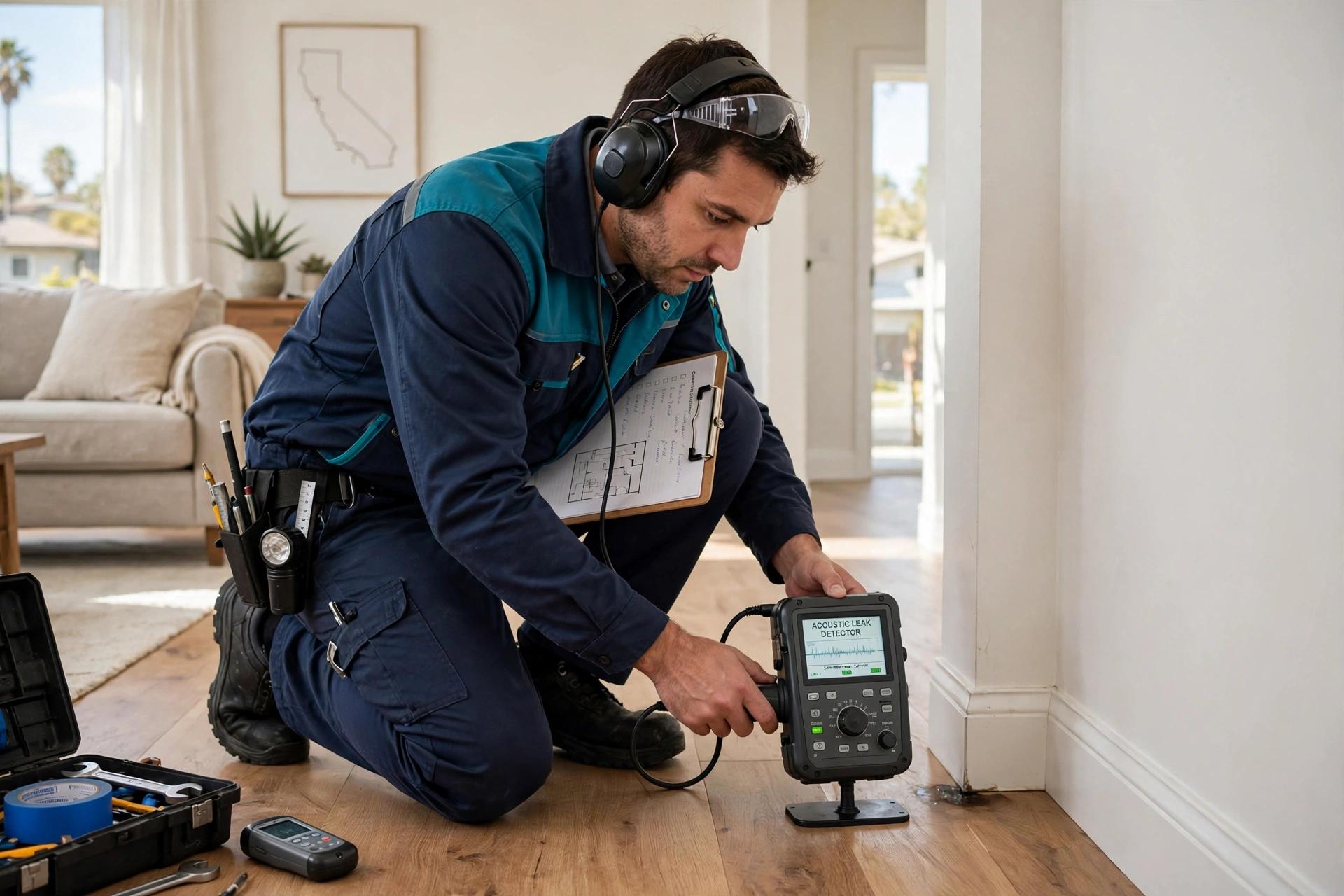
A detection visit includes a meter test to confirm the loss, isolation testing to narrow it to one part of the system, and pinpointing with acoustic listening, thermal imaging or tracer gas. It finishes with the leak marked, the readings documented, and repair options explained. Nothing gets cut open during detection.
That sequence matters. Skipping the first steps and going straight to a sensor is how leaks get "found" in the wrong place. The confirmation and isolation stages are cheap, fast, and they stop the expensive tools being pointed at the wrong end of the house.
How do you know it's a leak and not just high usage?
Start with the meter. With every tap, appliance and irrigation zone off, a healthy system shows a still meter. If the low-flow indicator turns, water is moving through a closed system, and physics says it has to be going somewhere. Toilets are the first suspect — a flapper that doesn't seal can pass hundreds of gallons a day without a sound — so dye in the tank rules that in or out in ten minutes.
If the meter still moves, the pattern of use tells the next part of the story. A leak on a pressurised supply line runs 24 hours a day, including at 3 a.m. when nobody is awake to use water. Smart meter data, where a California utility offers it, shows that overnight flow clearly. Usage problems stop when the house sleeps. Leaks don't. That distinction is what the first stage of a visit is built to prove, one way or the other.
Which tools find which kind of leak?
Acoustic listening is the workhorse. Escaping water makes noise, and a trained ear with ground microphones can follow that noise along a pipe to its loudest point. Thermal imaging handles the leaks sound can't reach quickly: a hot-water line leaking under a slab draws a warm shape on the camera that shows both the area and the direction of spread. Moisture meters then map how far water has travelled through walls and flooring, which matters because the wettest spot is rarely the break itself.
For the quiet ones — small leaks, plastic pipe that carries sound badly, long buried runs — tracer gas is the fallback that rarely misses. The line is drained, filled with a safe gas mix, and the gas rising through soil or concrete at the leak point is picked up by a detector at the surface. Leak noise correlation covers distance: two sensors clamped on a long line calculate the leak's position from the time delay between them. A good technician carries all of it and picks based on the pipe, not on habit.
What happens after the leak is pinpointed?
You get the location marked on the floor, wall or ground, photographs of the instrument readings, and a written summary of which tests were run and what they showed. That document is worth keeping. It supports an insurance claim, it lets a repair plumber quote from facts instead of guesses, and it protects you if the first repair quote sounds like it was written for a different house.
Detection and repair are separate decisions. Some firms do both, some only detect. Either way, the detection findings belong to you, and a repair crew that wants to re-run its own exploratory digging after a proper pinpoint should be asked why. The usual next step is a single, small opening at the marked spot — the difference between a patch of flooring lifted and a room demolished on a hunch.
How the visit runs
Meter test first
Confirm water is moving through a closed system before any other tool comes out.
Isolate the branches
House, irrigation, pool and main line get separated so the loss belongs to one system.
Pinpoint with the right sensor
Acoustic, thermal, correlation or tracer gas, chosen for the pipe material and depth.
Mark it and write it up
The spot is marked, readings photographed, and the findings handed to you in plain language.
What affects the cost of water leak detection?
- Whether the loss is in the house, the main line, irrigation or a pool — each is a different hunt
- Pipe material: plastic lines carry sound poorly and can push the job toward tracer gas
- Depth and surface: a leak under a driveway or pool deck takes longer to confirm than one under a floor
- How much of the system is undocumented — additions and remodels add isolation time
- Whether one leak or several are present on the same line
Prices are set after the tests show what the job actually is. Anyone quoting a firm figure before testing is guessing.
Water Leak Detection questions, answered
How much water can a hidden leak waste?
More than most people expect. A pinhole leak at normal household pressure can lose several hundred gallons a day, and a running toilet can pass a thousand. On a California water bill that adds up fast, and the water damage bill that follows a slow leak usually dwarfs the water bill itself.
Can a leak be inside a wall with no visible stain?
Yes. Water follows framing and vapour barriers and can travel a long way before it shows. A wall cavity leak may first appear as a musty smell, a baseboard that swells, or paint that bubbles in one small patch. Moisture mapping exists for exactly this: it traces the wet path back toward the source instead of trusting the stain.
Do I need to shut off my water before the visit?
No — the technician needs the system live to test it. Do note where your main shut-off is, and if the leak is actively flooding, close it and say so when you call. For a slow hidden leak, just clear access to the meter, the water heater and any manifold or shut-off valves you know about.
Will the visit find leaks in every part of the property?
A general visit covers the house supply system, the main service line and, on request, irrigation and pool lines. Each extra system adds test time, so say what you suspect when booking. If a test shows the loss sits in a system that needs a specialist follow-up, you'll be told plainly rather than sold a vague answer.
Need water leak detection?
Call and talk to our team in your city.