Underground & Main Line Leak Detection in California
The main service line is the most expensive pipe on a property to get wrong.
It runs buried from the street meter to the house, often under the driveway, the landscaping and decades of tree growth, and when it leaks there is no stain on a ceiling to guide anyone — just a spinning meter and a patch of yard that never dries. Underground leak detection is the discipline of finding that break to within a shovel's width before the ground is opened. This page explains how buried-line leaks show themselves, how correlation and tracer gas locate them, and why the order of the tests matters more than the digging.
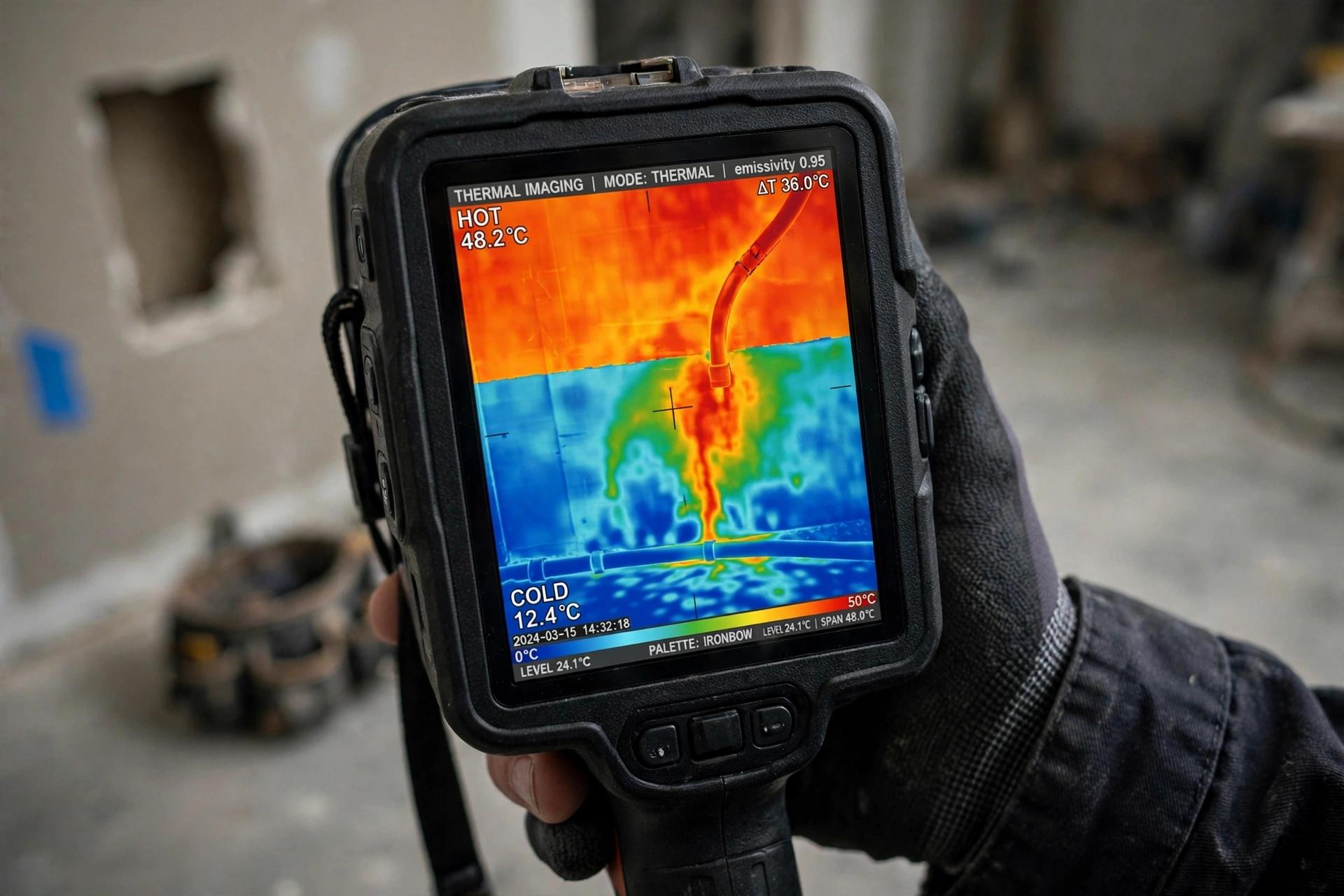
How does underground leak detection find buried leaks?
Underground leaks are found by isolating the buried line with pressure testing, then locating the break with leak noise correlation — sensors at two points calculate the leak's position — or with tracer gas that rises through the soil at the leak. The spot is marked before any digging begins.
Correlation changed this work. Instead of listening along a whole street's worth of pipe, two sensors and a timing calculation give a distance from a known fitting. Combined with an electronic trace of the line's route, the digging shrinks from a trench to a hole. That combination is what modern underground leak detection is built on.
The signs of a buried line leak
A main-line leak has a short list of tells. The meter moves with the house shut off at its own valve — the test that separates a buried-line problem from a house problem. One patch of lawn stays green and soft while the rest dries out. A section of driveway or path develops a crack, a dip or a damp edge that never quite dries. And in quiet houses, there's sometimes a faint, constant hiss at the point where the line enters the building.
Roots complicate everything. Tree roots in California yards actively grow toward the moisture at a leaking joint, and what starts as a weeping fitting becomes a root-bound break. Soil type matters too: a leak in sandy soil can drain away silently for months, while the same leak in clay pushes water to the surface within weeks — which is why two neighbours with the same failure can have completely different symptoms.
Correlation, listening and gas: the underground leak detection toolkit
The visit starts with isolation. The house is valved off and the buried line is pressure tested on its own, confirming the loss is underground and measuring roughly how big it is. Then an electronic locator traces the line's actual route — which, on properties that have been remodelled and re-landscaped, is frequently not the straight line everyone assumes. Every later measurement depends on knowing where the pipe actually runs.
With the route traced, correlators clamp onto the meter and the house entry point. The leak's noise reaches the two sensors at different times, and the difference, with the pipe material and length, gives a position. Ground microphones then verify on the surface above that position. Where the line is plastic, deep, or the leak is small and quiet, tracer gas does the confirming instead: it escapes at the break, rises through the soil, and registers on a detector walked across the yard. The result is a marked point with a depth estimate — what an excavation crew actually needs.
Repair choices for a buried line
Once the break is marked, the choices are a spot excavation and repair, or replacing the line's failing section — and the deciding factor is the pipe's material and condition, not the leak alone. A single break in sound pipe is a one-hole job. A galvanised or badly corroded line that has failed once is telling you about the rest of its length, and a full replacement, sometimes trenchless, can be the cheaper five-year answer even when it's the dearer quote today.
Detection protects you in this conversation. With a marked location, a measured loss rate and the line's route on paper, repair quotes can be compared like for like. Without them, every quote is a guess with a different trench attached. A good underground leak detection report states the pipe's condition plainly, so that choice is yours to make with evidence. Keep the detection report with the property records — the next owner, and the next plumber, will both be glad it exists.
How the visit runs
Valve off the house
The buried line is tested alone so a house leak can't muddy the result.
Trace the route
An electronic locator maps where the pipe actually runs under the property.
Correlate the noise
Two sensors calculate the leak's position along the line from timing.
Verify at the surface
Ground microphone or tracer gas confirms the spot before it's marked.
What affects the cost of underground & main line leak detection?
- Line length and depth — a long run under a big lot takes more correlation work
- Pipe material: plastic lines are quiet and can push the job to tracer gas
- Surface cover: lawn is kind, concrete driveways and mature landscaping are not
- Whether the route is documented or has to be traced from scratch
- Tree roots and soil type, which affect both the testing and the digging that follows
Prices are set after the tests show what the job actually is. Anyone quoting a firm figure before testing is guessing.
Underground & Main Line Leak Detection questions, answered
How do I tell a main line leak from a house leak?
Close the shut-off valve where the line enters the house, then check the meter. If it still moves, water is escaping between the meter and that valve — the buried line. If it stops, the loss is inside the house system. This two-minute test is the first thing a technician will do, and it's worth doing before you call.
Can a main line leak damage my driveway or foundation?
Yes. Escaping water erodes the soil supporting whatever sits above the line — driveway slabs crack and settle, and a leak near the house can soften the ground at the foundation's edge. The water bill is the least of it. A soggy patch that keeps spreading is the ground telling you the wash-out is growing.
How accurate is underground leak detection by correlation?
On a line with good sensor access at both ends, correlation typically places a leak within a foot or so. Accuracy depends on knowing the pipe material and the true distance between sensors, which is why the route trace comes first. The surface verification step then confirms the calculated point before anyone digs.
Who is responsible for the line from the meter to my house?
In most California cities, the homeowner owns everything on the house side of the meter, including the buried service line. The utility's responsibility usually ends at the meter itself. Your detection report will show exactly where the leak sits relative to the meter, which settles the question if there's any doubt.
Need underground & main line leak detection?
Call and talk to our team in your city.