Commercial Leak Detection in California
A commercial leak is a different problem from a house leak, mostly because of scale and paperwork.
The system is bigger — multiple buildings, long underground runs, irrigation networks, cooling and fire lines — the meter is often shared, and the person paying for the work usually isn't the person who found the wet patch. A commercial survey is built for that reality: zone-by-zone isolation that finds the loss without shutting a property down, and documentation written for property managers, HOA boards and insurers rather than for a homeowner standing in a kitchen. This page covers how a commercial survey runs and what separates a useful one from a walk-around with a stethoscope.
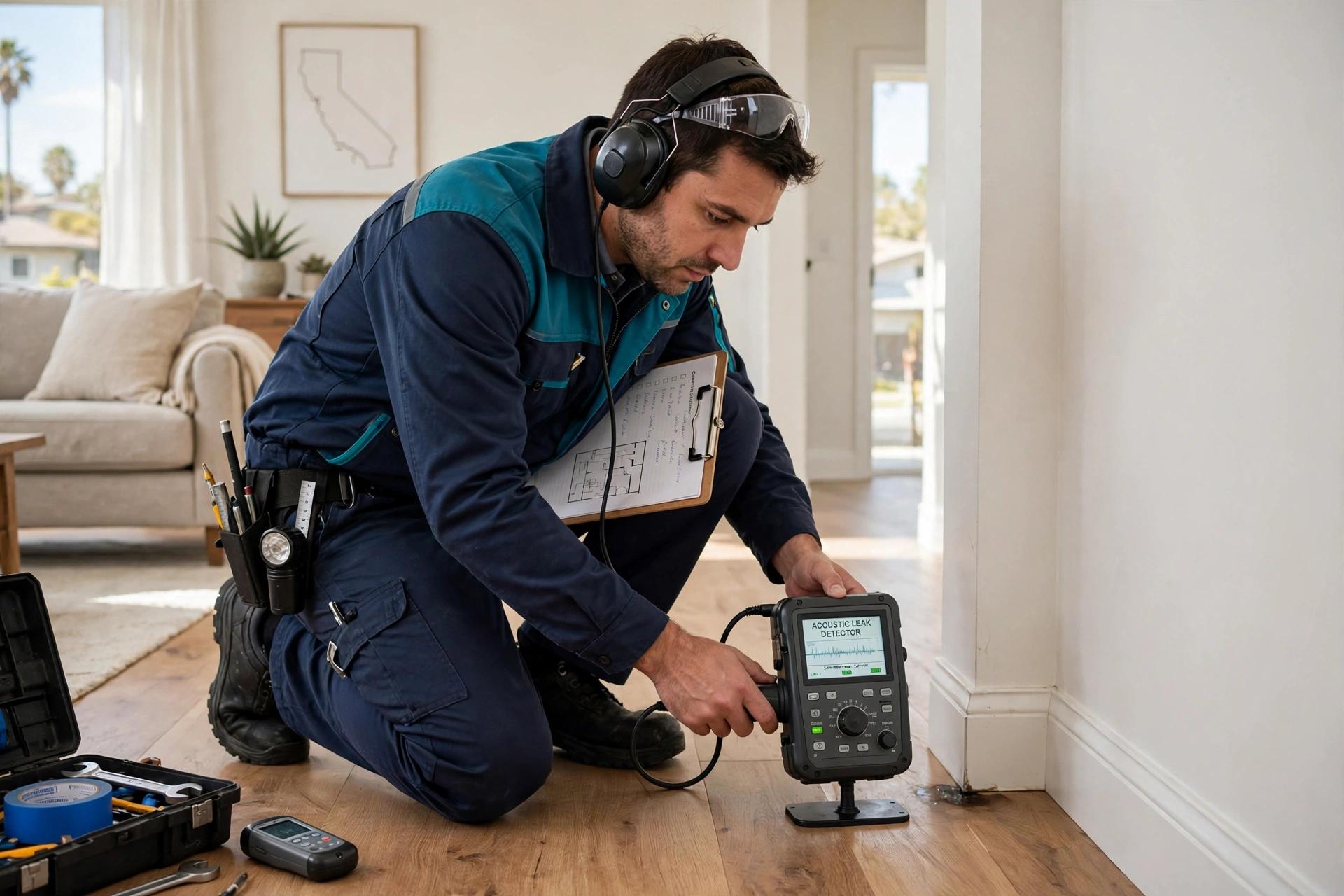
What does commercial leak detection involve?
It involves splitting the property's water system into zones, testing each zone's consumption and pressure to find which one is losing water, then pinpointing the leak within that zone using acoustic, correlation or tracer-gas equipment. Findings are delivered as a written report with locations, readings and photos.
The report is not an afterthought on a commercial job — it's half the product. Boards approve repairs from documents, insurers pay claims from documents, and a manager defending a water bill dispute with a utility needs meter data, not recollections.
Zone by zone: how a big system gets searched
Nobody acoustically surveys three acres of pipe on foot as a first step. A commercial job starts with the water data: meter reads, sub-meter reads where they exist, and the property's billing history. A complex losing water usually shows it as a base load that never reaches zero — the overnight minimum flow is the number that matters, because legitimate use at 3 a.m. is close to nothing. That figure alone sizes the problem before a single tool comes out.
Then the system gets divided. Buildings, irrigation zones, pool systems and underground runs are valved off in turn while the meter is watched, until the loss is assigned to one zone. Only then does pinpointing start, with the same acoustic, correlation and thermal tools used on houses, applied to a search area that isolation has already shrunk to a manageable size. The property keeps running throughout — zones are tested in sequence, not shut down together.
The leaks commercial properties actually have
Underground main and lateral lines top the list, quietly losing water for months because nobody walks the whole run. Irrigation is next: broken heads and stuck valves waste water on a schedule, at night, where nobody sees it. Then come the building systems — slab lines in ground-floor units, risers, and the slow fixture leaks across dozens of bathrooms that no single tenant reports but the master meter feels. Cooling towers and water features add their own losses on larger sites.
What makes these expensive is rarely the water alone. It's the undermined parking lot, the unit that has to be dried out, the liability question when a tenant's ceiling comes down. A survey that finds the loss early, with dates and readings attached, is the cheapest version of every one of those stories.
Working with managers, boards and insurers
A proper commercial report lists each zone tested, the method used, the readings taken, and the marked locations with photographs. It separates confirmed leaks from suspected ones and says plainly which is which. That separation matters: a board can approve a repair on a confirmed finding today and budget a re-test on a suspicion next quarter, and an insurer can see exactly what was known and when.
Scheduling is part of the service too. Testing that needs quiet conditions happens early or after hours; work near tenants is announced and access is coordinated through management. If your property has been chasing a water bill that doesn't make sense, the first deliverable to ask for is the overnight flow figure — everything else in the survey builds on it.
How the visit runs
Start with the data
Meter and billing history establish the overnight base load — the size of the problem.
Isolate by zone
Buildings, irrigation and underground runs are valved off in turn to assign the loss.
Pinpoint in the zone
Acoustic, correlation, thermal or tracer-gas work narrows the zone to a marked spot.
Report for decision-makers
Locations, readings and photos in a document a board or insurer can act on.
What affects the cost of commercial leak detection?
- Property size and the number of separate zones and buildings
- Whether sub-meters exist or the whole survey hangs off one master meter
- Underground run lengths and surface cover across the site
- Access coordination — occupied units, business hours, after-hours testing
- The depth of documentation required for boards, insurers or utility disputes
Prices are set after the tests show what the job actually is. Anyone quoting a firm figure before testing is guessing.
Commercial Leak Detection questions, answered
Can testing happen without shutting the property down?
Yes. Zones are isolated and tested one at a time, so the rest of the property keeps its water. A brief shut-off to a single building or line may be needed for a specific pressure test, and that gets scheduled with management in advance — early mornings are typical — rather than sprung on tenants.
Our water bill keeps rising but no leak is visible. Where do we start?
With the overnight minimum flow. Read the master meter last thing at night and first thing in the morning over a few days, or ask for the data if the utility offers interval reads. A property with no legitimate overnight use that still consumes steadily has a loss, and that figure becomes the baseline the survey works to explain.
Do you survey irrigation systems as well?
Yes, and on many California properties irrigation is where the water goes. Stuck valves, cracked lateral lines and broken heads run on timers, usually at night. Irrigation zones are isolated and tested as their own zones in a survey, and the findings separate plumbing losses from irrigation losses so each loss gets the right fix.
What does the final report include?
Each zone tested, the tests used, the readings, marked leak locations with photographs, and a clear split between confirmed findings and areas that need monitoring or re-testing. It's written for people who weren't on site — managers, board members, insurers — and it stands on its own without the technician in the room to explain it.
Need commercial leak detection?
Call and talk to our team in your city.