Leak Detection Porterville, CA
If your water bill climbed this month and nothing in the house changed, the leak is probably already there.
In Porterville, detection crews get called for the same handful of clues again and again: the sound of water when every tap is off, damp spots that never dry, and meters that won't sit still. This page is a plain guide to leak detection in Porterville — the tools used, the order they're used in, what a visit actually involves, and how pricing is figured. No scare tactics, just the process, plus the local factors around the Central Valley that shape where leaks turn up.
What does leak detection in Porterville involve?
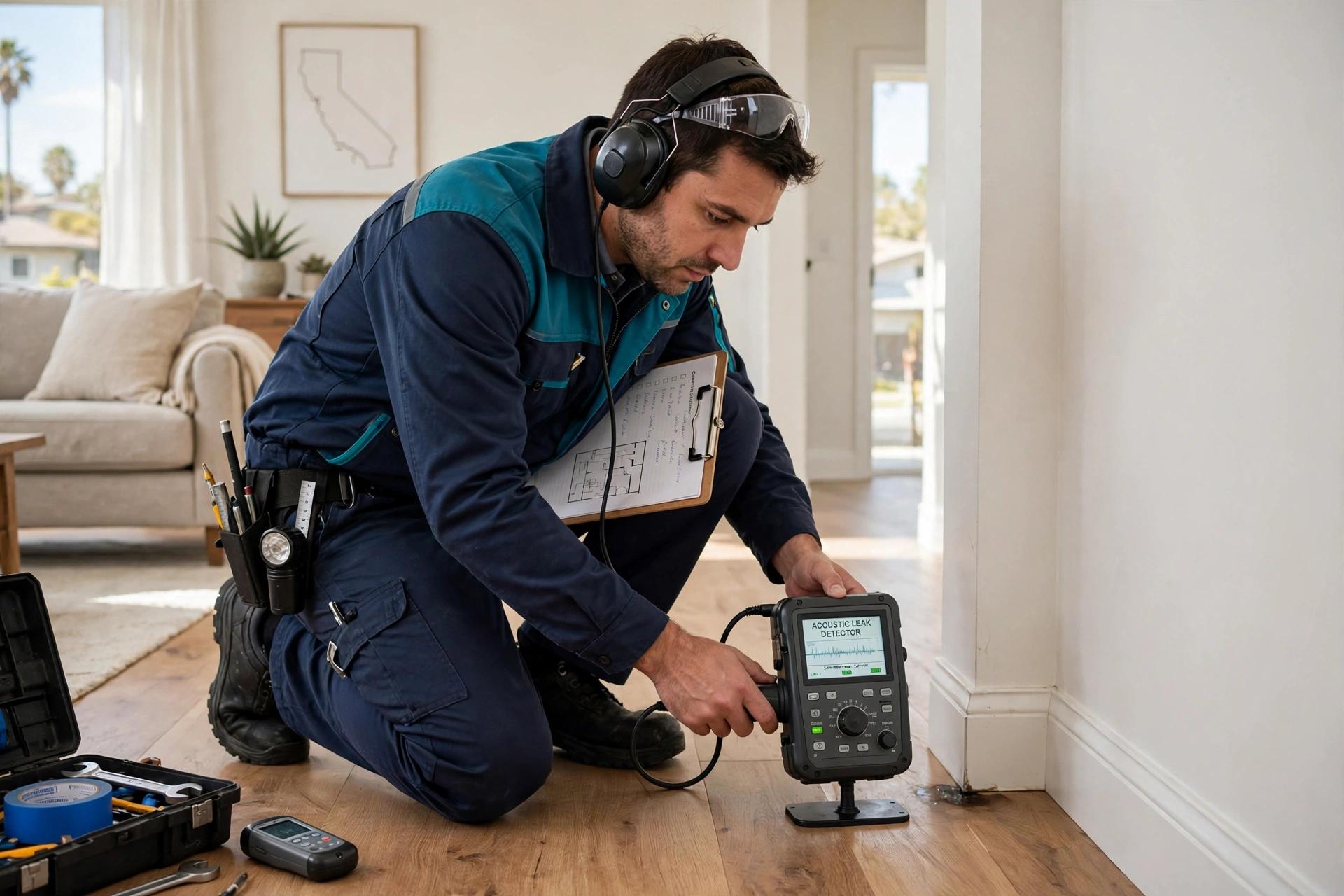
A leak detection visit in Porterville starts with a water-meter test to confirm water is moving when it shouldn't be. The technician then uses acoustic listening gear, thermal imaging and isolation testing to narrow the leak to a single spot, usually within a couple of hours and without cutting into walls or floors.
From there the visit follows the evidence. If the loss is on a hot line, thermal imaging usually shows its path. If it's quiet or buried, tracer gas or correlation takes over.
Leak Detection Porterville: Which Properties We Inspect
Most of the housing in Porterville is suburban: single-family homes on slabs, with irrigation, a water heater and often a pool or spa out back. At roughly 3,356 people per square mile, lots are big enough for a long run of buried line between the meter and the house, and for plenty of sprinkler plumbing. That mix means three places to check before anyone suspects the house itself: the main service line, the irrigation system and the pool equipment.
How to Catch a Leak Early at Home in Porterville
You don't need equipment to spot most leaks early. A few habits catch the common ones, and they cost almost nothing.
- Find your main shut-off valve now and make sure it turns. In an emergency, seconds matter
- Read your water meter at night and again in the morning with everything off. Any change points to a leak
- Replace old rubber washing-machine and dishwasher hoses with braided stainless lines before they burst
- Check static water pressure with a simple hose-bib gauge. Most codes, including California's, call for a regulator when pressure runs above 80 psi
- Look at irrigation zones while they run for geysers, soggy patches and mismatched heads
Signs there's a hidden leak in your Porterville home
Some signs are easy to miss because the house still works. Water flows, showers run, and the only thing out of place is a number — the bill, the meter reading, the square footage of a stain that grows a little each week.
- A water bill that's suddenly higher with no change in how much water you use
- A pool or spa that loses water faster than evaporation explains
- Your water meter keeps moving even though every tap and appliance is off
- Warm or soft spots on floors, which often point to a hot-water slab leak
- Cracks appearing in flooring, tile grout or the slab itself
Why leaks happen in the Central Valley
Hard water is the headline in the Central Valley. Mineral-heavy water eats copper from the inside, and pinhole leaks are a familiar problem in Porterville homes that are only 20 or 30 years old. Add expansive soils that shift with farm irrigation and dry summers, and slab lines take stress from above and below. Agricultural areas also mean long private service lines and well systems on some properties, where a leak can run a pump ragged before anyone sees a symptom indoors. Meter and pressure tests come first here, because they separate a house leak from a supply-side problem quickly.
How technicians pinpoint a leak without digging
Pressure and meter testing
Before any fancy gear comes out, the basics settle the argument. A water-meter test shows whether water is moving with everything shut off. A hydrostatic pressure test then isolates the system: sections are pressurised and watched to see which one loses pressure. In Porterville, this step decides which system is losing the water: the house plumbing, the main service line, the irrigation, or the pool. Once one system is proven to be the loser, every later test is aimed at that system alone.
Acoustic listening
Pressurised water escaping a pipe makes a sound, and that sound travels along the pipe and through the ground. A technician with ground microphones and headphones works across the floors and yard in Porterville, following the noise to its loudest point. Leak noise correlation takes it further: two sensors on the line compare timing to calculate where between them the leak sits.
Moisture mapping
Water travels. The wet spot on a Porterville wall or floor is often a foot or more from the actual break, because moisture follows framing, gravel beds and the path of least resistance. Moisture mapping uses pin and pinless meters to chart how far the water has spread and in which direction it's coming from.
What affects the cost of leak detection?
There's no honest flat answer, because the price follows the job. What we can do is lay out what actually moves it, so a quote for your Porterville home makes sense when you hear it.
- Where the leak is — an exposed line in a garage costs less to trace than a deep run under a slab or driveway
- Which tests the job needs — a meter test and acoustic pass is quicker than a tracer-gas job on a drained line
- How many leaks there are — older copper often has more than one weak spot, and each needs its own pinpoint
- Access — finished floors, tile, pool decks and locked crawlspaces all change how long the visit runs
- Whether the system is documented — a known pipe layout speeds isolation testing; an unknown one takes longer to map
- What happens next — detection ends with a marked spot and a written summary; repair is quoted separately
How a detection visit works, step by step
Confirm the leak
A meter test establishes whether water is actually being lost, and roughly how fast.
Isolate the system
Branches are shut down one at a time until the loss is narrowed to one section.
Pinpoint it
Acoustic gear, thermal imaging or tracer gas marks the exact spot.
Mark and explain
You get the spot marked, photos of the readings, and a plain explanation of repair options.
Leak Detection Porterville: Common Leak Problems We Locate
A "hidden leak" is not one problem. For leak detection Porterville homeowners rely on, the cause behind a spinning meter is usually one of a short list, and knowing which one decides the test order.
- Slab leaks: a break in a supply line under or inside the concrete foundation, usually a hot-water line, found with thermal imaging and acoustic listening
- Pinhole leaks in copper pipe: tiny pits eat through the pipe wall from the inside, often at bends and joints, and can leak for months before a stain shows
- Fixture and appliance leaks: toilet flappers, dishwasher and washing-machine hoses, ice-maker lines and shower valves that leak inside the wall
- Main water line leaks: a failure on the buried service line between the meter and the house, which can show up as a soggy yard or low pressure
- Pool and spa leaks: loss from skimmer lines, return fittings, light niches or buried plumbing, confirmed with a bucket test and pressure testing
Leak Detection Porterville — Local Coverage and Response
Coverage in Porterville runs on a regular route through ZIP codes 93257 and 93258. With around 3,356 people per square mile, call volume here is steady, and the housing mix means one street can hold three generations of pipe: galvanized steel in the oldest homes, copper in the mid-century builds, and PEX in the newest. A technician who works the Central Valley regularly knows which of those he's likely to meet at your door, and brings the test gear that reads clearly on that material. The same routes also cover Tulare, Delano and Corcoran, so a Porterville call is rarely a long drive for the crew.
Leak Detection Porterville Services — Slab, Pool, Main Line and Emergency
Every service below is part of our leak detection Porterville coverage, for homeowners, landlords and businesses. Pick the one that matches your symptoms, or call and we'll point you to the right test.
- Water Leak Detection in Porterville — Whole-house leak finding for supply lines, walls, floors and yards — meter test first, pinpoint second, no guesswork.
- Slab Leak Detection in Porterville — Pinpointing leaks in lines under the concrete slab — warm-floor mapping, acoustic confirmation, one mark before anyone cuts.
- Pool & Spa Leak Detection in Porterville — Bucket test first, then every line pressure tested on its own — skimmer, returns, cleaner line, lights and fittings dye-tested.
- Underground & Main Line Leak Detection in Porterville — Buried service lines, yard lines and irrigation feeds — correlation and tracer gas that find the break before the digging starts.
- Commercial Leak Detection in Porterville — Leak surveys for apartment complexes, HOAs, retail and light industrial — large systems isolated zone by zone, documented for managers and insurers.
- Emergency Leak Detection in Porterville — Active flooding, burst lines and fast slab leaks — what to shut off now, what a priority visit does first, and how the pinpoint follows.
Leak Detection Porterville — Questions Porterville Homeowners Ask
What is a slab leak, and are they common around Porterville?
A slab leak is a break in a water line that runs under or inside the concrete foundation. Hot-water copper lines are the usual victims, and the first signs are a warm floor, a hissing sound or a bill that climbs for no reason. Slab leak detection marks the exact spot so the repair means opening one small section of floor, not breaking up half the slab.
How long does a leak detection visit take in Porterville?
Most homes take one to three hours. A straightforward supply-line leak can be confirmed and marked quickly, while a quiet leak on a long buried line or under a pool deck needs more time for isolation and tracer-gas work. The technician can usually tell you which kind of job you have after the first meter and pressure checks.
Will leak detection damage my floors or walls?
No. Acoustic listening, thermal imaging, moisture meters and pressure tests all work from the surface, so nothing is opened up during the search. Cutting only happens at the repair stage, at the spot the technician marked, which is normally a small opening instead of a search through the floor.
Does homeowners insurance cover leak detection in California?
Policies vary, but a common pattern is that sudden water damage to the home is covered while the pipe repair itself is not, and detection is sometimes covered when it's needed to find a covered loss. Ask your insurer before the visit, and keep the written findings and photos of the readings, because they support a claim.
Do you check irrigation and main service lines too?
Yes, and it matters in Porterville, where the ZIP codes 93257 and 93258 routes include long runs from the meter to the house. Isolation testing separates the house, irrigation and main line so the visit ends with the right section identified, not a guess.
Can a leak be found inside a wall or ceiling without opening it?
Usually yes. Thermal imaging shows temperature differences on the surface, moisture meters chart how far the water has spread, and acoustic sensors pick up the sound of pressurised water. Together they narrow the leak to a small area, so any cut into the drywall is one small opening in the right place.
Book Leak Detection Porterville Today
For leak detection Porterville calls, one number reaches our local team. The visit starts with a meter test and ends with the leak marked — no guesswork, and the repair decision stays yours.