Leak Detection Lodi, CA
A hidden water leak rarely announces itself in Lodi.
It shows up as a meter that keeps spinning, a warm patch on the floor, or a water bill that jumps for no clear reason. With about 67,607 people spread across roughly 14 square miles in the North Coast & Sierra Foothills, homes here sit on a mix of pipe materials and soil conditions, and a small pinhole leak can run for weeks before anyone notices. This page covers how leak detection works in Lodi, what raises the risk locally, and how a non-invasive inspection finds the exact spot before a repair crew opens anything up.
What does leak detection in Lodi involve?
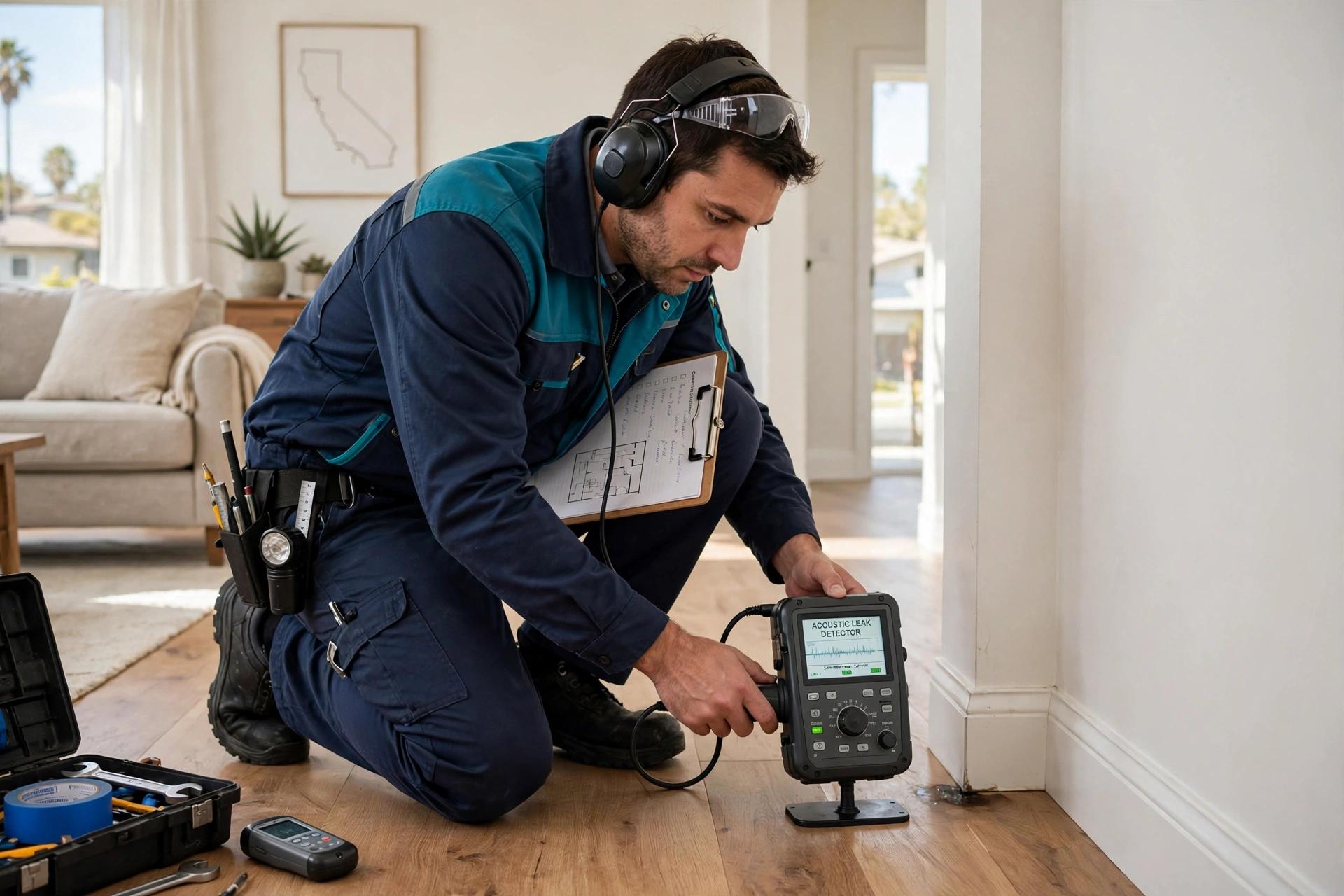
A leak detection visit in Lodi starts with a water-meter test to confirm water is moving when it shouldn't be. The technician then uses acoustic listening gear, thermal imaging and isolation testing to narrow the leak to a single spot, usually within a couple of hours and without cutting into walls or floors.
From there the visit follows the evidence. If the loss is on a hot line, thermal imaging usually shows its path. If it's quiet or buried, tracer gas or correlation takes over.
How to Catch a Leak Early at Home in Lodi
You don't need equipment to spot most leaks early. A few habits catch the common ones, and they cost almost nothing.
- Look at irrigation zones while they run for geysers, soggy patches and mismatched heads
- Read your water meter at night and again in the morning with everything off. Any change points to a leak
- Drop a few drops of food colouring in the toilet tank. If colour reaches the bowl without flushing, the flapper is leaking
- Check static water pressure with a simple hose-bib gauge. Most codes, including California's, call for a regulator when pressure runs above 80 psi
- Watch for new cracks, damp baseboards or a musty smell, and take a photo to track whether they grow
Signs there's a hidden leak in your Lodi home
Some signs are easy to miss because the house still works. Water flows, showers run, and the only thing out of place is a number — the bill, the meter reading, the square footage of a stain that grows a little each week.
- The sound of running water when the house is quiet
- A water bill that's suddenly higher with no change in how much water you use
- Damp, musty smells that stay in one room or one cabinet
- A pool or spa that loses water faster than evaporation explains
- Low water pressure on one fixture or one side of the house
Why leaks happen in the North Coast & Sierra Foothills
Properties in the North Coast & Sierra Foothills play by different rules. Many Lodi homes run on wells and septic systems, sit on sloped lots, and have long buried lines between the well, the tank and the house. A leak on one of those runs may never show indoors at all — it shows up as a pump that cycles too often or a pressure tank that won't hold. Freeze-thaw cycles at elevation also split pipes that would last decades on the coast. Detection here focuses on pressure testing each run separately, so the failing stretch is identified before any digging starts.
How technicians pinpoint a leak without digging
Pressure and meter testing
Before any fancy gear comes out, the basics settle the argument. A water-meter test shows whether water is moving with everything shut off. A hydrostatic pressure test then isolates the system: sections are pressurised and watched to see which one loses pressure. In Lodi, this step decides which system is losing the water: the house plumbing, the main service line, the irrigation, or the pool. Once one system is proven to be the loser, every later test is aimed at that system alone.
Isolation testing
Isolation testing is the process of elimination, done properly. Valves close off one branch at a time — a bathroom group, the water heater feed, the irrigation zone — while the meter or a pressure gauge tells the technician when the loss stops. For older Lodi homes with decades of add-on plumbing, this is often the step that makes sense of a confusing system.
Tracer gas
When a leak is too quiet for acoustic gear — small, deep, or under a pool deck — the line gets drained and filled with a safe tracer gas mix. The gas escapes at the leak and rises straight up, where a sensitive detector sniffs it out at the surface. It's slower than listening, and it costs more to run, but around Lodi it's the method that finds the leaks other tools miss. Because the gas is harmless and the test is non-invasive, nothing is cut or removed until the exact spot is confirmed.
What affects the cost of leak detection?
There's no honest flat answer, because the price follows the job. What we can do is lay out what actually moves it, so a quote for your Lodi home makes sense when you hear it.
- Where the leak is — an exposed line in a garage costs less to trace than a deep run under a slab or driveway
- Which tests the job needs — a meter test and acoustic pass is quicker than a tracer-gas job on a drained line
- How many leaks there are — older copper often has more than one weak spot, and each needs its own pinpoint
- Access — finished floors, tile, pool decks and locked crawlspaces all change how long the visit runs
- Whether the system is documented — a known pipe layout speeds isolation testing; an unknown one takes longer to map
- What happens next — detection ends with a marked spot and a written summary; repair is quoted separately
How a detection visit works, step by step
Confirm the leak
A meter test establishes whether water is actually being lost, and roughly how fast.
Isolate the system
Branches are shut down one at a time until the loss is narrowed to one section.
Pinpoint it
Acoustic gear, thermal imaging or tracer gas marks the exact spot.
Mark and explain
You get the spot marked, photos of the readings, and a plain explanation of repair options.
Leak Detection Lodi: Common Leak Problems We Locate
A "hidden leak" is not one problem. For leak detection Lodi homeowners rely on, the cause behind a spinning meter is usually one of a short list, and knowing which one decides the test order.
- Water heater and supply-line leaks: corroded fittings, tank connections and flexible hoses that drip behind closets and cabinets
- Fixture and appliance leaks: toilet flappers, dishwasher and washing-machine hoses, ice-maker lines and shower valves that leak inside the wall
- Main water line leaks: a failure on the buried service line between the meter and the house, which can show up as a soggy yard or low pressure
- Pressure-related leaks: a failed pressure-reducing valve (PRV) pushes line pressure too high and stresses every joint in the house
- Irrigation and sprinkler leaks: broken heads, cracked risers and failed valves that waste water outdoors and push the water bill up
Leak Detection Lodi: Which Properties We Inspect
Lodi is a dense place, around 4,942 people per square mile, so a lot of the work is in townhomes, condos, apartment buildings and older single-family lots built close together. Shared walls and stacked units change the job: water from one leak can show up in a neighbour's ceiling, and the first task is working out which unit's line is actually losing water. Property managers and HOA boards in Lodi often book detection before opening any walls, because a marked spot keeps the repair, and the disruption to residents, as small as possible.
Leak Detection Lodi — Local Coverage and Response
Coverage in Lodi runs on a regular route through ZIP codes 95240, 95241 and 95242. With around 4,942 people per square mile, call volume here is steady, and the housing mix means one street can hold three generations of pipe: galvanized steel in the oldest homes, copper in the mid-century builds, and PEX in the newest. A technician who works the North Coast & Sierra Foothills regularly knows which of those he's likely to meet at your door, and brings the test gear that reads clearly on that material. The same routes also cover Galt, Lathrop and Manteca, so a Lodi call is rarely a long drive for the crew.
Leak Detection Lodi Services — Slab, Pool, Main Line and Emergency
Every service below is part of our leak detection Lodi coverage, for homeowners, landlords and businesses. Pick the one that matches your symptoms, or call and we'll point you to the right test.
- Water Leak Detection in Lodi — Whole-house leak finding for supply lines, walls, floors and yards — meter test first, pinpoint second, no guesswork.
- Slab Leak Detection in Lodi — Pinpointing leaks in lines under the concrete slab — warm-floor mapping, acoustic confirmation, one mark before anyone cuts.
- Pool & Spa Leak Detection in Lodi — Bucket test first, then every line pressure tested on its own — skimmer, returns, cleaner line, lights and fittings dye-tested.
- Underground & Main Line Leak Detection in Lodi — Buried service lines, yard lines and irrigation feeds — correlation and tracer gas that find the break before the digging starts.
- Commercial Leak Detection in Lodi — Leak surveys for apartment complexes, HOAs, retail and light industrial — large systems isolated zone by zone, documented for managers and insurers.
- Emergency Leak Detection in Lodi — Active flooding, burst lines and fast slab leaks — what to shut off now, what a priority visit does first, and how the pinpoint follows.
Leak Detection Lodi — Questions Lodi Homeowners Ask
Should I turn the water off if I suspect a leak?
If water is actively flooding a room or a line has burst, yes: close the main shut-off valve right away, then call. For a slow, hidden leak, you can leave the water on for the visit, since pressure testing and acoustic work need the line live. Knowing where your main valve is before there's a problem saves time in an emergency.
Can you find a leak in my pool or spa?
Yes. Most pool and spa leaks in Lodi turn out to be in the plumbing, a skimmer line, a return fitting or a light niche rather than the shell itself. A bucket test separates evaporation from a real loss, then pressure testing of the suction and return lines and dye or listening tests locate the break.
Do you check irrigation and main service lines too?
Yes, and it matters in Lodi, where the ZIP codes 95240, 95241 and 95242 routes include long runs from the meter to the house. Isolation testing separates the house, irrigation and main line so the visit ends with the right section identified, not a guess.
How do I know if I have a hidden leak in Lodi?
Check the meter first. Turn off every tap, appliance and irrigation zone, then watch the low-flow indicator on the water meter for 15 minutes. If it keeps turning, water is escaping somewhere in a closed system. Other clues are a bill that jumped without any change in use, a warm patch on the floor, or the sound of running water in a quiet Lodi house.
My water bill doubled. What should I do first?
Start with the cheap checks: a running toilet is the single most common cause, followed by irrigation timers and stuck valves. If those pass, do the meter test. A moving meter with everything off means a real loss, and that's the point where a Lodi detection visit pays for itself in water alone.
Will leak detection damage my floors or walls?
No. Acoustic listening, thermal imaging, moisture meters and pressure tests all work from the surface, so nothing is opened up during the search. Cutting only happens at the repair stage, at the spot the technician marked, which is normally a small opening instead of a search through the floor.
Book Leak Detection Lodi Today
For leak detection Lodi calls, one number reaches our local team. The visit starts with a meter test and ends with the leak marked — no guesswork, and the repair decision stays yours.