Pool & Spa Leak Detection in California
A pool that needs topping up every few days is telling you something.
In a California summer, evaporation takes its share — but it takes a predictable share, and a leak doesn't follow the weather. Pool leak detection is the process of separating those two, then finding exactly where the water goes: a cracked return line, a skimmer throat that's let go, a light niche, the shell itself. This page covers how that process works, why most pool leaks turn out to be plumbing rather than structure, and what to check yourself before you book a visit.
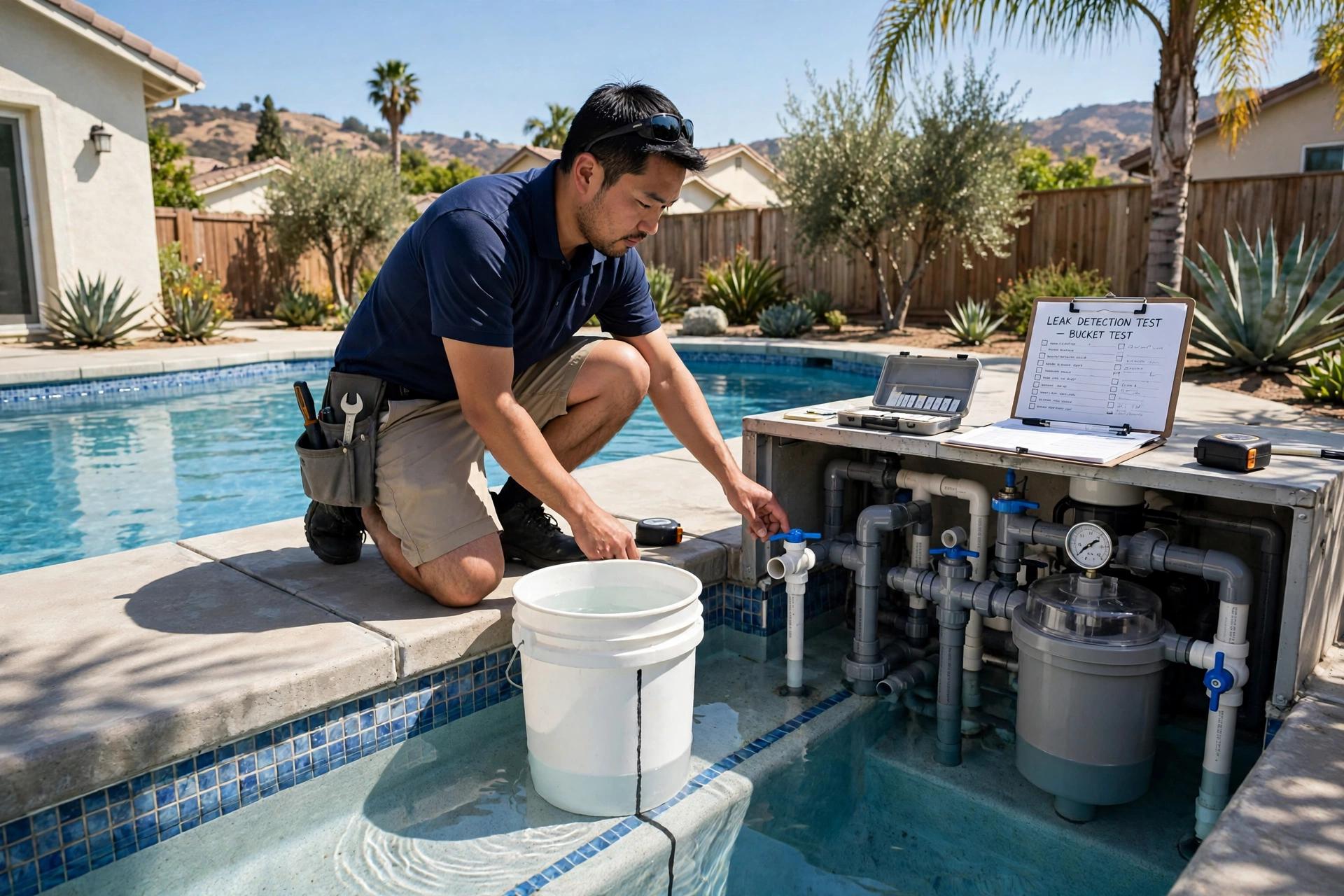
How do you find a leak in a pool?
Pool leak detection starts with a bucket test to separate evaporation from a real loss. Then each plumbing line is pressure tested individually, and fittings, skimmers and lights are dye tested. Most pool leaks are found in the plumbing or at a fitting, not in the pool shell.
The bucket test is free and worth doing before anyone visits: it converts a suspicion into a measurement. If the pool drops faster than the bucket over 24 hours with the pump both on and off, the pattern of those two results already hints at whether the leak is in the circulation plumbing or the structure. That measure-first habit is what pool leak detection is built on.
Evaporation or leak? The bucket test settles it
Fill a bucket with pool water, set it on a step so the water levels inside and outside start equal, mark both, and wait 24 hours. If the pool level falls further than the bucket's, the difference is water leaving by a route other than the sky. Run it twice — once with the pump running as usual, once with it off. A loss that only happens with the pump on points at the pressure side of the plumbing. A loss that continues with everything off points at the shell, a fitting, or the suction side.
Context matters too. A heated spa, a water feature and a windy week all raise evaporation. But evaporation doesn't soak the equipment pad, doesn't keep one patch of decking damp, and doesn't make the autofill run daily. When the bucket test and the symptoms agree, a detection visit stops being a maybe and becomes the obvious next step.
Line by line: how pool leak detection tests the plumbing
Pool plumbing fails at joints, and joints live at the skimmer, the returns, the cleaner line and the main drain. The technician isolates each run, plugs the ends, and pressurises it — with water or air — while watching a gauge. A line that holds pressure is cleared. A line that bleeds it is the leak's home, and listening equipment or a camera then narrows down where along that run the break sits, which decides whether the fix is a fitting repair or a section of deck that has to open.
The shell and fittings get a different tool: dye. A tiny amount of dye released near a skimmer throat, a light niche, a return fitting or a visible crack will drift toward a leak and disappear into it, visible to the trained eye in still water. Tile-line cracks and separated skimmers are common California findings, especially in older plaster pools that have lived through decades of summers and the odd earthquake tremor.
Why pool leaks get expensive when they're ignored
A leaking return line doesn't just waste water and chemicals. Underground, the escaping water erodes the soil supporting the deck and the shell, and a void under a deck slab eventually announces itself as a crack or a hollow sound underfoot. The equipment suffers too: a suction-side leak pulls air, the pump loses prime and runs dry, and a pump replacement costs more than the detection visit that would have prevented it.
There's also the simple arithmetic. An inch a week from a mid-size pool is thousands of gallons a month, treated and heated water included. Pool leak detection is methodical rather than exotic — a set of tests, each clearing one suspect — and it ends with the leak assigned to a specific line or fitting, which is what a repair quote needs to be worth anything.
How the visit runs
Bucket test
Evaporation is measured and ruled out, with the pump on and off.
Isolate the systems
Shell and plumbing are separated so the loss is assigned to one of them.
Pressure test each line
Skimmer, returns, cleaner and drain lines are tested one at a time.
Dye test the fittings
Skimmers, lights and visible cracks are checked with dye in still water.
What affects the cost of pool & spa leak detection?
- How many separate lines the pool has — spas, water features and cleaners each add a run to test
- Whether the leak is in the plumbing (usually simpler) or the shell (needs different access)
- Deck material over the lines: concrete, pavers and stone change what confirmation looks like
- Access to the equipment pad and how the system was plumbed originally
- Whether the spa shares equipment with the pool or runs its own system
Prices are set after the tests show what the job actually is. Anyone quoting a firm figure before testing is guessing.
Pool & Spa Leak Detection questions, answered
How much water loss is normal for a California pool?
In hot, dry weather, a quarter inch a day can be honest evaporation, and more with a spa or water feature running. The bucket test is the only reliable way to judge your own pool, because wind, shade and temperature vary so much. Any loss beyond the bucket's, or a damp equipment pad, deserves a proper test.
Can a pool leak be in the light?
Yes. The light niche and its conduit are a classic leak point: water escapes around the fixture or travels up the conduit and out at the junction box. Dye testing at the light, with the pump off and the water still, shows it clearly. It's also one of the cheaper pool leaks to fix once it's confirmed.
Do I need to drain the pool for pool leak detection?
Almost never. Pressure testing and dye testing are done with the pool full — the water is part of the test. Draining is a repair-stage decision for certain shell work, and even then it's partial. If a company wants the pool emptied just to look for the leak, ask what test requires that.
My pool only loses water when the pump runs. What does that mean?
That pattern points to the pressure side of the plumbing — the return lines that carry water back to the pool under pump pressure. With the pump off, those lines sit at low pressure and leak slowly or not at all. A line-by-line pressure test confirms which run it is, and that result usually leads to a localised repair rather than a plumbing overhaul.
Need pool & spa leak detection?
Call and talk to our team in your city.